PRT & EAET
Pain Reprocessing Therapy & Emotional Awareness and Expression Therapy
The pain is real. The nervous system may be part of why it keeps going.

Medical evaluation may not explain the pain.
The nervous system can become sensitized—learning to interpret sensations, movements, stress, or other experiences as signs of danger even when ongoing injury does not fully account for the symptoms.
DeepWaters uses approaches including Pain Reprocessing Therapy (PRT) and Emotional Awareness and Expression Therapy (EAET) to help appropriate clients reduce learned threat, work with emotional processes that may be contributing to pain, and create new experiences of safety.
When Pain Becomes an Alarm That Keeps Sounding
Pain is designed to protect you.
When you are injured or something is wrong, pain gets your attention and encourages you to respond.
But sometimes the nervous system can become sensitized. Sensations that are not signaling ongoing danger may still trigger a very real pain response.
A cycle can develop:
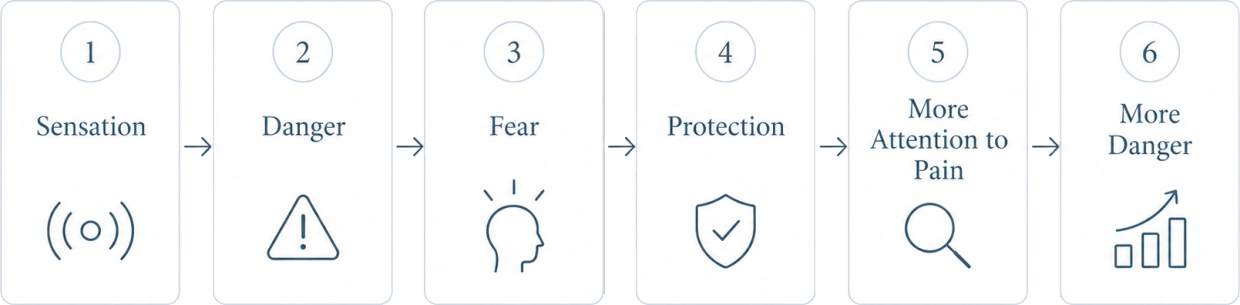
You may begin monitoring your body constantly, avoiding movement, bracing for symptoms, or worrying that pain means additional damage is occurring.
Stress, conflict, fear, and other emotional experiences may also increase the nervous system's perception of threat.
Those responses are understandable.
If the nervous system has learned danger, therapy may be able to help it learn greater safety.
Two Ways We May Work With Persistent Pain
Pain Reprocessing Therapy
Emotional Awareness and Expression Therapy
Emotional Awareness and Expression Therapy
Pain Reprocessing Therapy is a psychological treatment developed for certain forms of persistent or neuroplastic pain. PRT focuses primarily on how the brain and nervous system interpret bodily sensations.
When appropriate, the work helps you experience sensations with less fear and provide the nervous system with new information:
This sensation is real—but it may not mean I am being damaged.
PRT helps you explore whether the nervous system may be interpreting safe bodily sensations as threatening and, when appropriate, begin responding to those sensations differently.
The goal is not to convince yourself that the pain isn't real.
The goal is to help the brain and nervous system distinguish more accurately between:
hurt and harm
sensation and danger
discomfort and damage
Over time, repeated experiences of safety may help reduce the brain's need to generate or amplify a protective pain response.
Emotional Awareness and Expression Therapy
Emotional Awareness and Expression Therapy
Emotional Awareness and Expression Therapy
EAET focuses more directly on emotional experiences that may be contributing to nervous-system threat.
The work may involve identifying emotions that have been avoided, suppressed, or difficult to experience; understanding how past or current relationships affect the nervous system; and learning to experience and express emotion in healthier ways.
EAET does not assume that pain is “caused by emotions.”
Instead, it recognizes that for some people, stress, trauma, emotional conflict, and patterns of emotional avoidance can interact with the brain and nervous system in ways that influence pain.
Persistent pain doesn't happen in a vacuum.
Our bodies respond to relationships, stress, loss, fear, anger, shame, trauma, conflict, and experiences we may have learned not to feel or express.
EAET helps you become more aware of those emotional experiences and, when appropriate, experience and express them in ways that feel safe, direct, and useful.
The goal is to reduce the emotional and physiological threat that may be keeping the nervous system activated.
What Might Treatment Actually Look Like?
Treatment is individualized. PRT and EAET are tools, not a rigid protocol that every person follows in the same way.
The work may include several overlapping areas.
01 — Understand the Pain
02 — Reduce Fear and Reinterpret Sensations
02 — Reduce Fear and Reinterpret Sensations
We begin by looking carefully at your symptoms, medical history, patterns, triggers, and the information you've received from medical providers.
We look for evidence that may suggest nervous-system sensitization or a neuroplastic component to the pain.
We don't begin by assuming your pain is neuroplastic.
Appropriate medical evaluation matters.
02 — Reduce Fear and Reinterpret Sensations
02 — Reduce Fear and Reinterpret Sensations
02 — Reduce Fear and Reinterpret Sensations
Persistent pain can understandably create fear.
You may worry about movement, monitor every sensation, brace for a flare, or organize more and more of your life around preventing pain.
When medically appropriate, PRT helps you begin approaching sensations with greater curiosity and less threat.
The question gradually shifts from:
“What's wrong with me?”
toward:
“Could this sensation be uncomfortable without being dangerous?”
03 — Practice Somatic Tracking
02 — Reduce Fear and Reinterpret Sensations
04 — Explore Emotional Patterns
Somatic tracking is one of the core tools used in PRT.
Rather than fighting, avoiding, or intensely monitoring a sensation, you learn to observe it with curiosity while introducing accurate messages of safety.
This can involve:
mindful awareness • curiosity • safety reappraisal • reduced fear • positive emotional experience
The point is not to force the pain away.
The practice is about changing your relationship with the sensation and giving the nervous system new information.
04 — Explore Emotional Patterns
05 — Express What Needs Expression
04 — Explore Emotional Patterns
When emotional processes appear relevant, EAET may help us look more closely at what the nervous system has learned to protect you from.
This might include:
stress • loss • anger • fear • shame • trauma • relationship conflict • unmet needs • difficult boundaries • emotional suppression
Rather than only understanding those experiences intellectually, therapy may help you safely experience emotions that have been difficult to access or express.
Emotions themselves are not the enemy.
Learning that you can experience strong emotion without being overwhelmed by it can also become an experience of safety.
05 — Express What Needs Expression
05 — Express What Needs Expression
05 — Express What Needs Expression
Sometimes pain exists alongside a long history of holding things in.
You may have learned to:
- keep the peace;
- avoid anger;
- take care of everyone else.
When relevant, EAET can help you practice healthier emotional expression, assertiveness, boundaries, and communication.
The purpose is not confrontation for its own sake.
It is developing greater freedom to feel, communicate, and respond without your nervous system having to carry everything for you.
06 — Re-Engage With Life
05 — Express What Needs Expression
05 — Express What Needs Expression
Pain can gradually make life smaller.
You stop exercising. You avoid certain movements. Travel becomes difficult. Work changes. Social activities disappear. You become less confident in your body.
When medically appropriate, therapy may include gradually approaching activities that have become associated with fear or pain.
The goal is not reckless “pushing through.”
It is helping the nervous system learn, through experience, that more movement, emotion, connection, and activity may be safer than it has come to expect.
Pain is not “all in your head.”
Neuroplastic or nociplastic pain is real pain.
The distinction is not between “real pain” and “imaginary pain.”
The question is what processes are contributing to the pain.
For some conditions, ongoing injury, inflammation, disease, or nerve damage remains important.
For others, changes in how the nervous system processes threat and bodily sensation may contribute significantly to persistent symptoms.
Emotional and relational stress can also influence that threat system.
And for many people, more than one process may be involved.
Understanding the nervous system's role does not make the pain less real.
What Does the Research Say?
Both PRT and EAET have encouraging research support, although neither approach is appropriate for every person or every type of pain.
Research on PRT
Research on EAET
Research on EAET
A randomized clinical trial of adults with primary chronic back pain found substantially greater reductions in pain among participants receiving PRT compared with placebo treatment and usual care.
Improvements were largely maintained at one-year follow-up, and a later five-year follow-up found continued differences in pain intensity among participants originally assigned to PRT.
Research on EAET
Research on EAET
Research on EAET
EAET has also been studied across several chronic-pain populations.
In a randomized clinical trial involving older veterans with chronic musculoskeletal pain, EAET produced greater reductions in pain severity than cognitive behavioral therapy both immediately after treatment and at six-month follow-up.
EAET has also been studied in people with fibromyalgia. Results have shown improvements in several symptoms and functioning outcomes, with some advantages over comparison treatments.
What this research does not mean
It does not mean every case of chronic pain is neuroplastic or emotionally driven.
The research does suggest that for appropriately selected people, changing learned threat responses and working with relevant emotional processes can be meaningful components of chronic-pain treatment.
Could This Approach Be Appropriate for Me?
PRT, EAET, or an integrated approach may be worth exploring when:
- pain has persisted despite appropriate medical evaluation;
- ongoing tissue damage or disease does not fully explain the symptoms;
- pain changes considerably with stress, attention, activity, context, or emotional state;
- symptoms move, fluctuate, disappear and return, or behave in ways that seem difficult to explain structurally;
- fear of symptoms or movement has begun restricting your life;
- you find yourself constantly monitoring your body for signs of pain;
- periods of stress, conflict, or emotional intensity seem connected with symptom changes;
- trauma, loss, relationship experiences, or difficult emotions appear relevant to the larger picture;
- you tend to suppress emotions, avoid conflict, overfunction, or put your own needs aside;
- a medical professional has suggested that central sensitization, nociplastic pain, or other nervous-system processes may be involved; or
- you're interested in exploring the relationship between pain, emotion, stress, and the nervous system.
Not all chronic pain is neuroplastic.
New symptoms, significant changes in symptoms, and medically concerning symptoms should be evaluated by an appropriate healthcare professional.
Psychotherapy does not replace medical diagnosis or necessary medical care.
Pain has taken enough from your life.
You don't need to be certain that your pain is neuroplastic.
You don't need to know whether PRT, EAET, or another approach is the right one.
If you've received appropriate medical care but pain continues to limit your movement, relationships, work, or quality of life, we can begin by looking carefully at the pattern.
Online therapy for Adults in Texas & Colorado
THE CLIENT PORTAL, EMAIL, PHONE NUMBER AND CONTACT FORMS ARE NOT TO BE USED FOR EMERGENCY SITUATIONS.
IF YOU ARE EXPERIENCING AN EMERGENCY PLEASE CALL 988 OR GO TO THE NEAREST EMERGENCY ROOM.
CRISIS TEXT LINE: 741741 or CrisisTextLine.org
NATIONAL SUICIDE PREVENTION HOTLINE: 800-273-8255
PES (AUSTIN & TRAVIS COUNTY): 512-472-4357
BLUEBONNET TRAILS (ROUND ROCK/GEORGETOWN): 800-841-1255
ROCK SPRINGS (GEORGETOWN/CEDAR PARK/KILLEEN) 512-819-9400
This website uses cookies.
We use cookies to analyze website traffic and optimize your website experience. By accepting our use of cookies, your data will be aggregated with all other user data.